

PostgreSQL Autovacuum Tuning & XID Wraparound: Preventing the 2-Billion Transaction ID Crisis
Comprehensive architectural guide on PostgreSQL Autovacuum internals, 32-bit transaction ID (XID) aging, tuple freezing, anti-wraparound vacuum mechanics, production capacity planning, and incident runbooks.
PostgreSQL Autovacuum Tuning & XID Wraparound: Preventing the 2-Billion Transaction ID Crisis
Category: DBA Guide · PostgreSQL · Deep Architecture Topics Technical Level: Expert Reading Time: 22–25 minutes Recommended URL: /postgresql/autovacuum-tuning-xid-wraparound-prevention/ Reference Article: postgres.ai — How to Monitor Transaction ID Wraparound Risks
Summary
In PostgreSQL, Autovacuum is far more than a simple housekeeping daemon for purging dead tuples. It is the fundamental protective infrastructure that guarantees Multi-Version Concurrency Control (MVCC) durability and prevents catastrophic database lockouts caused by Transaction ID (XID) Wraparound.
PostgreSQL's classic 32-bit transaction counter accommodates approximately 4.29 billion distinct IDs. However, because MVCC visibility comparison relies on modulo modular arithmetic, the engine operates within a safe comparison horizon of approximately 2.147 billion transactions ($2^{31}$).
When Autovacuum is misconfigured or suppressed, long-running queries, orphan replication slots, high write throughput, and saturated storage I/O can converge, driving the PostgreSQL cluster into emergency anti-wraparound protection mode.
This guide provides an exhaustive architectural breakdown of PostgreSQL Autovacuum internals, XID aging dynamics, tuple freezing mechanics, anti-wraparound vacuum behavior, production tuning configurations, capacity planning formulas, and emergency incident recovery runbooks.
1. PostgreSQL MVCC & Transaction ID Architecture
Under PostgreSQL MVCC, row versions are governed directly by transaction IDs. Each heap tuple header stores critical transaction identifiers in its xmin and xmax header fields.
| Header Field | Description |
|---|---|
xmin | Transaction ID that created (inserted) this tuple version |
xmax | Transaction ID that deleted or updated this tuple; also utilized for row-level locking |
t_ctid | Physical pointer to the tuple itself or the updated forward version in heap storage |
t_infomask | Bit flags encoding tuple visibility, commit/abort state, and frozen status |
t_infomask2 | Extended flags storing attribute count and Heap-Only Tuple (HOT) metadata |
PostgreSQL transaction IDs are 32-bit unsigned integers. Within this space, IDs 0, 1, and 2 are strictly reserved:
- •
0: InvalidTransactionId - •
1: BootstrapTransactionId - •
2: FrozenTransactionId
Normal client transactions begin incrementing sequentially from 3.
▸32-bit XID Space — Conceptual Ring Representation
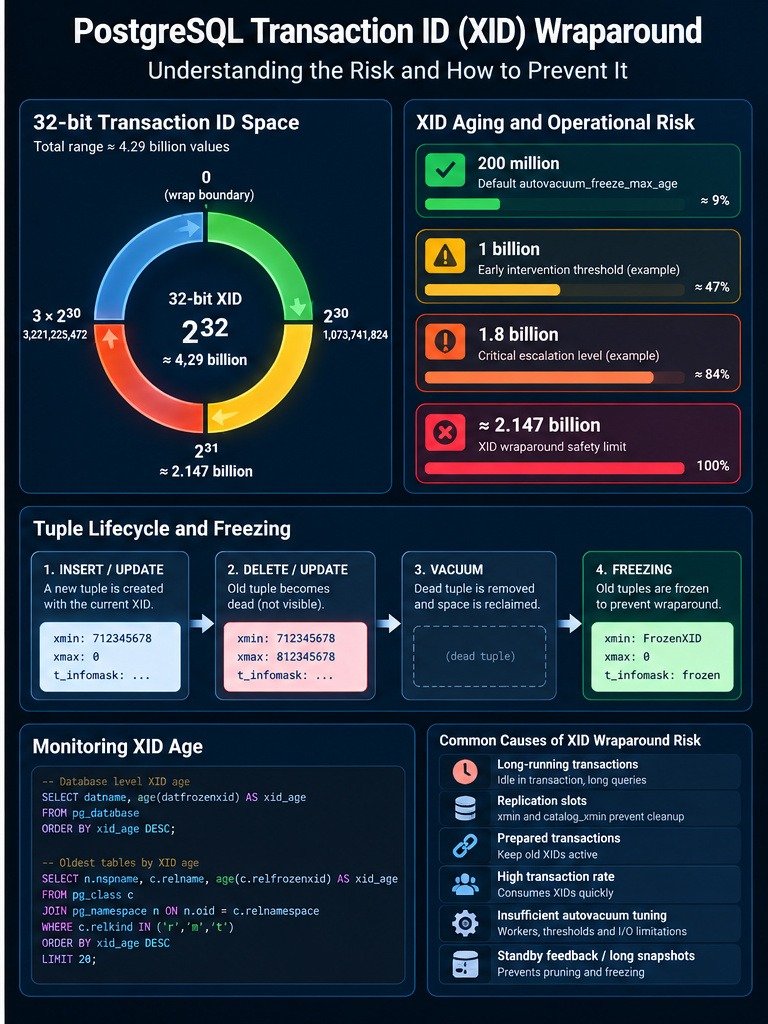
*Figure 1 — Schematic representation of the 32-bit modular transaction ring. Tuple visibility is interpreted dynamically relative to the current transaction baseline.*
▸1.1 Why 2 Billion Transactions Is the Critical Boundary
Half of the 32-bit space ($2^{31} \approx 2{,}147{,}483{,}648$) is allocated to past transactions, and the other half represents the future.
When a row version was created by a transaction that has fallen more than $2^{31}$ transactions behind the current counter, standard modular arithmetic ceases to recognize it as a past transaction. Instead, it is evaluated as residing in the future, instantly rendering historical tuples completely invisible—causing catastrophic, silent data corruption!
PostgreSQL resolves this challenge through the freezing mechanism.
In modern PostgreSQL versions, freezing is primarily accomplished by setting the HEAP_XMIN_FROZEN bit flag within t_infomask. Consequently, freezing does not always require physically overwriting the on-disk xmin field with FrozenTransactionId (2).
2. Autovacuum Internal Architecture
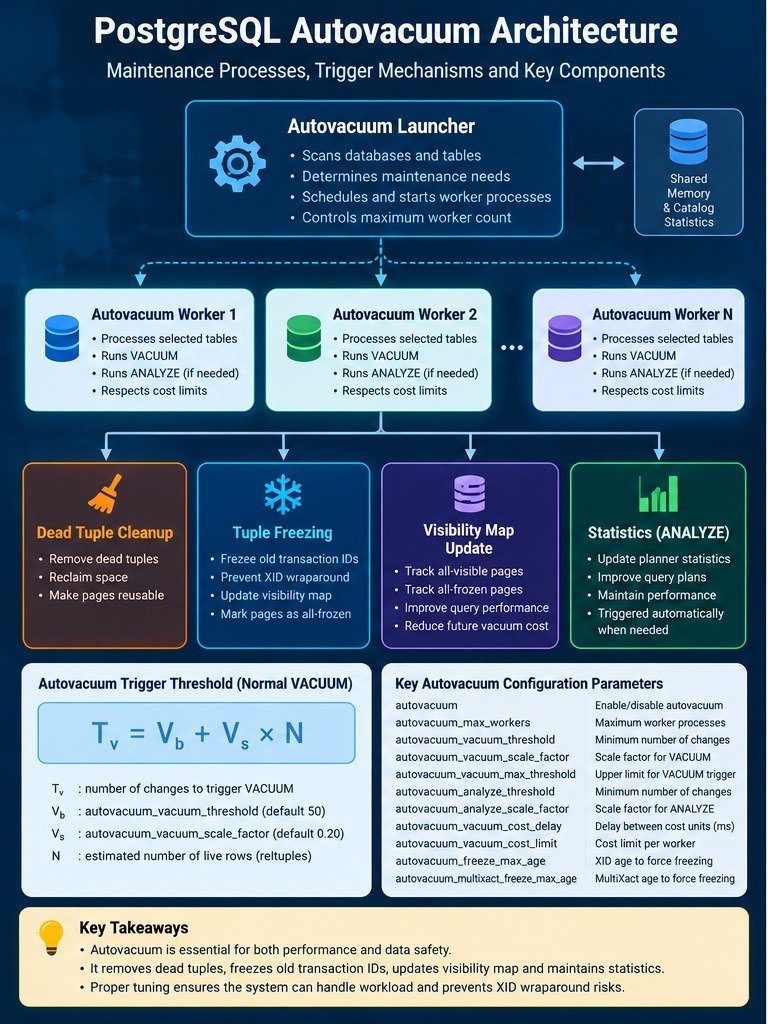
The PostgreSQL autovacuum daemon is divided into two distinct process tiers:
- 1Autovacuum Launcher: A permanent background daemon that continuously inspects system catalogs, schedules database sweeps, and spawns worker processes.
- 2Autovacuum Worker: Ephemeral worker processes spawned to execute
VACUUMandANALYZEoperations against eligible tables.
Autovacuum responsibilities extend well beyond dead tuple truncation: tuple freezing, visibility map page maintenance, Free Space Map (FSM) tracking, and planner histogram updates are executed within the autovacuum cycle.
▸Autovacuum Process Flow
▸2.1 When Does Autovacuum Trigger?
Standard VACUUM triggering on a table is evaluated using the following formula:
Where:
- •$V_b$:
autovacuum_vacuum_threshold(default: 50 tuples) - •$V_s$:
autovacuum_vacuum_scale_factor(default: 0.20 or 20%) - •$N$: Estimated live tuples in the table (
pg_class.reltuples)
In modern PostgreSQL releases, autovacuum_vacuum_max_threshold can provide an upper bound on this calculation.
For an untuned 100-million-row table under default settings:
This table will not trigger a standard autovacuum run until over 20 million UPDATEs or DELETEs accumulate!
autovacuum_vacuum_insert_threshold and autovacuum_vacuum_insert_scale_factor. Furthermore, XID freeze constraints (autovacuum_freeze_max_age) trigger mandatory anti-wraparound vacuums completely independent of dead tuple volume.3. How Transaction ID Wraparound Develops
Every transaction that mutates data or claims an XID advances the 32-bit counter.
A table's relfrozenxid catalog attribute marks the oldest unfrozen transaction ID remaining in that relation. As the age difference between current counter and relfrozenxid widens, wraparound risk escalates exponentially.
Querying cluster-wide database XID age:
SELECT
    datname,
    age(datfrozenxid) AS xid_age
FROM pg_database
ORDER BY xid_age DESC;
Because datfrozenxid reflects the oldest table in the database, DBAs must inspect relation-level age:
SELECT
    n.nspname AS schema_name,
    c.relname AS table_name,
    c.relkind,
    age(c.relfrozenxid) AS xid_age,
    c.relfrozenxid
FROM pg_class c
JOIN pg_namespace n ON n.oid = c.relnamespace
WHERE c.relkind IN ('r', 'm', 't')
ORDER BY age(c.relfrozenxid) DESC
LIMIT 30;▸3.1 Critical XID Age Thresholds
| XID Age | % of Horizon | Operational Status & Threshold |
|---|---|---|
| 200 Million | 9.3% | Default autovacuum_freeze_max_age triggering boundary |
| 1 Billion | 46.6% | Recommended proactive escalation and tuning alert |
| 1.8 Billion | 83.8% | High-priority operational emergency and incident escalation |
| ≈ 2.147 Billion | 100% | Absolute theoretical modular boundary ($2^{31} - 1$) |
WARNING: database "..." must be vacuumed within ... transactions). With 10 million transactions remaining, PostgreSQL stops allocating new transaction IDs entirely, rejecting all write transactions and entering emergency read-only mode to prevent silent data corruption!4. Tuple Freezing & The Visibility Map
Freezing enables PostgreSQL to retire ancient transaction IDs without losing transactional visibility integrity.
VACUUM evaluates rows against:
- •
vacuum_freeze_min_age: Minimum transaction age required before a tuple is eligible for freezing. - •
vacuum_freeze_table_age: Table age that forces aggressive whole-table freeze scans.
Advancing relfrozenxid requires scanning all unfrozen blocks.
▸The Critical Role of the Visibility Map
Each table relation maintains an accompanying Visibility Map (_vm fork) tracking two bit flags per 8 KB page:
| Flag Bit | Architectural Function |
|---|---|
| All-visible | Every tuple on the page is visible to all active transactions; allows Index-Only Scans. |
| All-frozen | Every tuple on the page is frozen. Subsequent VACUUM passes completely bypass reading this block! |
Pages marked all-frozen eliminate storage I/O during routine and anti-wraparound vacuum scans.
5. Production Autovacuum Tuning
Autovacuum requires tailored configurations adjusted for write velocity, relation volume, storage throughput, and replica topology.
For high-write OLTP tables, apply relation-level tuning parameters:
ALTER TABLE public.orders SET (
    autovacuum_vacuum_scale_factor = 0.01,
    autovacuum_vacuum_threshold = 1000,
    autovacuum_analyze_scale_factor = 0.02,
    autovacuum_analyze_threshold = 1000,
    autovacuum_vacuum_cost_limit = 2000
);▸5.1 Worker Capacity & I/O Budgeting
- •
autovacuum_max_workers: Maximum concurrent worker processes (default: 3). Simply increasing worker count without adjusting the I/O budget can degrade individual worker progress. - •
autovacuum_vacuum_cost_limit: Global I/O token budget distributed across active workers. - •
autovacuum_vacuum_cost_delay: Throttling pause (ms) applied when workers exhaust their cost slice (default: 2ms).
6. Projecting XID Crisis Timelines
Tracking XID age alone is insufficient; teams must calculate the XID consumption rate per day.
For example:
- •Current oldest XID age:
1,500,000,000(1.5B) - •Daily XID consumption:
20,000,000(20M/day) - •Emergency escalation threshold:
1,800,000,000(1.8B)
The remaining operational intervention window:
▸Capacity Forecast Model
| Metric | Sample Value | Operational Significance |
|---|---|---|
| Oldest XID Age | 1,500,000,000 | SELECT max(age(datfrozenxid)) |
| Daily Consumption Rate | 20,000,000 / day | Peak daily transaction velocity |
| Critical Escalation Level | 1,800,000,000 | Engineering incident threshold |
| Projected Runway | 15 Days | Window to remediate and execute maintenance |
7. Long Transactions & Replication Slot Hazards
Even with autovacuum running continuously, stale transactions and replication constructs can pin the global xmin horizon, preventing tuple reclamation and freezing progress:
- 1Long-Running Transactions & Idle in Transaction: Uncommitted transactions holding snapshots.
- 2Old `backend_xmin` Snapshots: Analytical queries delaying vacuum horizons.
- 3Inactive Logical Replication Slots: Unconsumed slots pin
catalog_xmin, freezing system catalog maintenance. - 4Orphaned Prepared Transactions (2PC): Uncommitted
PREPARE TRANSACTIONstate. - 5Standby Feedback Loops (`hot_standby_feedback = on`): Replica queries pinning the primary's cleanup horizon.
▸Identifying Blocking Sessions
SELECT
    pid,
    usename,
    state,
    xact_start,
    backend_xid,
    backend_xmin,
    age(backend_xmin) AS xmin_age
FROM pg_stat_activity
WHERE backend_xmin IS NOT NULL
ORDER BY age(backend_xmin) DESC;▸Inspecting Replication Slots
SELECT
    slot_name,
    slot_type,
    active,
    xmin,
    catalog_xmin,
    age(xmin) AS xmin_age,
    age(catalog_xmin) AS catalog_xmin_age
FROM pg_replication_slots;
8. Anti-Wraparound Autovacuum Behavior
When any table reaches autovacuum_freeze_max_age (default: 200M), PostgreSQL initiates mandatory anti-wraparound vacuums:
- •Operates with elevated process priority.
- •Overrides
autovacuum_enabled = falsetable options. - •Ignores standard deadlock cancellation timeouts.
▸Tracking Progress
SELECT
    p.pid,
    p.relid::regclass AS relation_name,
    p.phase,
    p.heap_blks_total,
    p.heap_blks_scanned,
    p.heap_blks_vacuumed,
    ROUND(100.0 * p.heap_blks_scanned / NULLIF(p.heap_blks_total, 0), 2) AS scan_pct
FROM pg_stat_progress_vacuum p;
9. Production Incident Runbook: XID Emergency Response
When XID age exceeds 1 billion, execute this structured sequence:
- 1Locate Critical Relations: Identify the top 5 oldest relations via
age(relfrozenxid). - 2Review PostgreSQL Logs: Check for wraparound warnings and worker starvation.
- 3Eliminate Horizon Blockers: Terminate idle sessions (
pg_terminate_backend), roll back prepared transactions, and drop stale replication slots. - 4Assess Storage & I/O: Ensure disk headroom and raise vacuum cost limits temporarily.
- 5Execute Targeted Manual Freezes: Run targeted freeze sweeps on oldest relations.
- 6Verify Age Regression: Confirm
age(relfrozenxid)drops below threshold.
▸Targeted Maintenance Execution
VACUUM (VERBOSE, FREEZE) public.orders;VACUUM FULL requires an exclusive table lock, writes a complete new copy of the relation, and can exhaust storage capacity, exacerbating downtime. Standard VACUUM (FREEZE) is strictly recommended.10. Monitoring & Alerting Strategy
Comprehensive XID protection requires multi-dimensional observability across metrics:
| Metric | Source View | Target |
|---|---|---|
age(datfrozenxid) | pg_database | Global database XID progression |
age(relfrozenxid) | pg_class | Relation-level freeze backlog |
age(datminmxid) | pg_database | MultiXact ID wraparound tracking |
n_dead_tup | pg_stat_user_tables | Dead tuple accumulation |
last_autovacuum | pg_stat_user_tables | Freshness of maintenance cycles |
heap_blks_scanned | pg_stat_progress_vacuum | Live vacuum throughput and phase |
slot_xmin | pg_replication_slots | Stale slot detection |
xid_velocity | Custom Metric | Daily consumption trend |
11. Architectural Design Principles
- •Workload-Aware Tuning: Tailor vacuum settings for high-update tables vs. append-only datasets.
- •Partition-Aware Maintenance: Partition large tables so frozen partitions require zero ongoing vacuum scans.
- •I/O-Aware Scheduling: Balance autovacuum concurrency against checkpoint writeback and peek traffic.
- •Replication-Aware Maintenance: Monitor replica lag, standby feedback, and logical replication slots.
- •Predictive Observability: Derive trends and forecast runway weeks prior to reaching threshold alerts.
12. Conclusion: Autovacuum Is a Data Durability Engine
In PostgreSQL, XID wraparound is an entirely preventable failure mode when systems are paired with disciplined observability and workload-aware configurations.
Suppressing autovacuum to reduce I/O overhead creates severe technical debt that eventually forces catastrophic outages.
Sustainable operations balance:
- 1Transaction Velocity
- 2Tuple Freezing Rate
- 3Maintenance Resource Allocation
The operational objective is never to minimize vacuum runs, but to ensure maintenance keeps pace with write workloads predictably and continuously.
References & Further Reading
- •PostgreSQL Documentation — Routine Vacuuming
- •PostgreSQL Documentation — Preventing Transaction ID Wraparound Failures
- •PostgreSQL Documentation — Automatic Vacuuming Configuration
- •postgres.ai — How to Monitor Transaction ID Wraparound Risks
▸DBA Guide Ecosystem Cross-Links
- •🛠️ [dataxtools.com](https://dataxtools.com): PostgreSQL Autovacuum & XID Wraparound Monitoring Tools Comparison
- •🚨 [dataopsphere.com](https://dataopsphere.com): XID Wraparound Incident Response & Escalation Runbook
Did increasing shared_buffers always improve performance in your PostgreSQL environment?
Share your observations regarding Linux Page Cache sizing, checkpoint spikes, and memory balancing across high-RAM PostgreSQL workloads.
PostgreSQL Shared Buffers & Linux Page Cache Interaction: The Hidden Layer of Memory Management
Comprehensive architectural guide on how PostgreSQL shared_buffers and Linux OS page cache interact, buffered I/O execution pipeline, double caching mechanics, cache hit ratio realities, and dual-layer tuning.
PostgreSQL WAL Architecture, Full Page Writes & Checkpoint Spreading Optimization
Comprehensive technical guide on PostgreSQL WAL architecture, Full Page Writes (FPW), checkpoint spreading via checkpoint_completion_target, and high-write tuning.