

PostgreSQL WAL Architecture, Full Page Writes & Checkpoint Spreading Optimization
Comprehensive technical guide on PostgreSQL WAL architecture, Full Page Writes (FPW), checkpoint spreading via checkpoint_completion_target, and high-write tuning.
PostgreSQL WAL Architecture, Full Page Writes & Checkpoint Spreading Optimization
Category: PostgreSQL → Performance Tuning → Storage & WAL Technical Level: Intermediate / Advanced Reading Time: 18–22 minutes Publication Series: DBA Guide | PostgreSQL Internals & Performance Tuning | Advanced Technical Guide
When evaluating PostgreSQL performance, attention typically centers on query optimization, index design, memory allocation, and storage I/O. Yet under heavy write workloads, an underlying tripartite mechanism dictates overall system stability: the interplay between Write-Ahead Logging (WAL), Full Page Writes (FPW), and Checkpoint scheduling.
These three components operate in close feedback loops. Checkpoint frequency directly dictates the volume of Full Page Images generated. Surging WAL volume subsequently increases storage write bandwidth, saturates streaming replication links, drives up archiving overhead, and extends recovery horizons.
This comprehensive guide examines PostgreSQL's WAL internals, explains how Full Page Writes prevent torn-page corruption, and demonstrates practical techniques for implementing checkpoint spreading across production clusters.
1. How PostgreSQL WAL Operates
Write-Ahead Logging represents the cornerstone of PostgreSQL's ACID durability and crash recovery model.
The governing invariant is straightforward:
This guarantees that following an unexpected host crash or power failure, PostgreSQL can reconstruct the cluster to a provably consistent state.
▸1.1 WAL Execution Flow
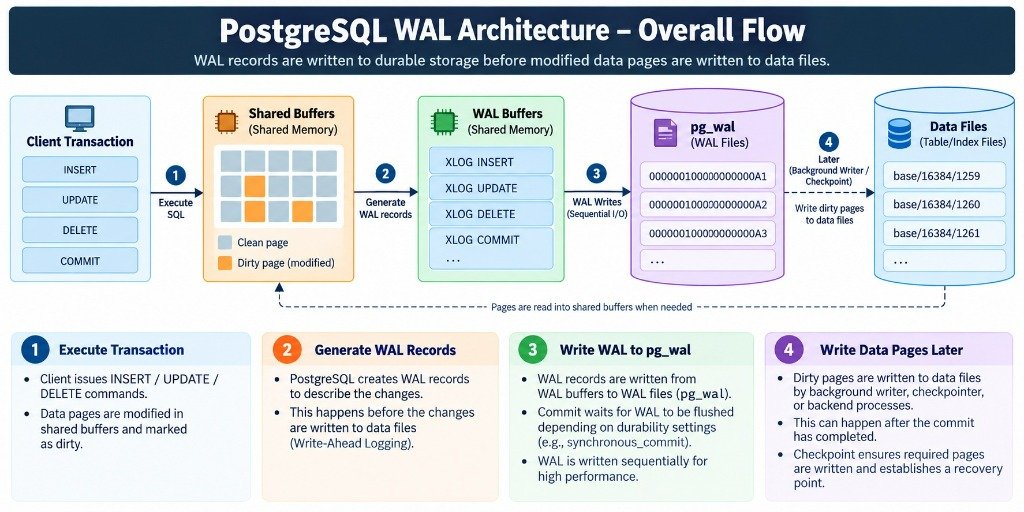
When an UPDATE executes, PostgreSQL carries out the following sequence:
- 1The target page is located and modified within Shared Buffers, marked as dirty.
- 2Binary WAL records representing the tuple change are created.
- 3WAL records are staged in WAL Buffers before being written out to WAL segment files.
- 4On transaction commit, WAL is flushed to disk according to durability configurations (
synchronous_commit). - 5Dirty data pages are asynchronously written out to storage by the background writer, checkpointer, or backend eviction.
Critically, a transaction commit does not block on flushing data pages to disk.
▸1.2 Structure of WAL Files
WAL records are stored as sequentially numbered 16 MB segment files in pg_wal.
SHOW wal_segment_size;
SHOW wal_level;
SHOW wal_buffers;
SHOW wal_compression;
WAL segments are essential for:
- •Physical streaming replication
- •Point-in-Time Recovery (PITR)
- •WAL archiving
- •Physical and logical backups
- •Change Data Capture (CDC) and logical replication
2. Full Page Writes (FPW)
PostgreSQL operates on 8 KB database blocks:
SHOW block_size;
SHOW full_page_writes;
Standard storage devices typically write in 512-byte or 4 KB sectors. If an 8 KB write is interrupted by a hardware fault or power outage, a partial write occurs—a condition known as a torn page.
Full Page Writes (FPW) eliminates this vulnerability.
▸2.1 Mechanics of Full Page Writes
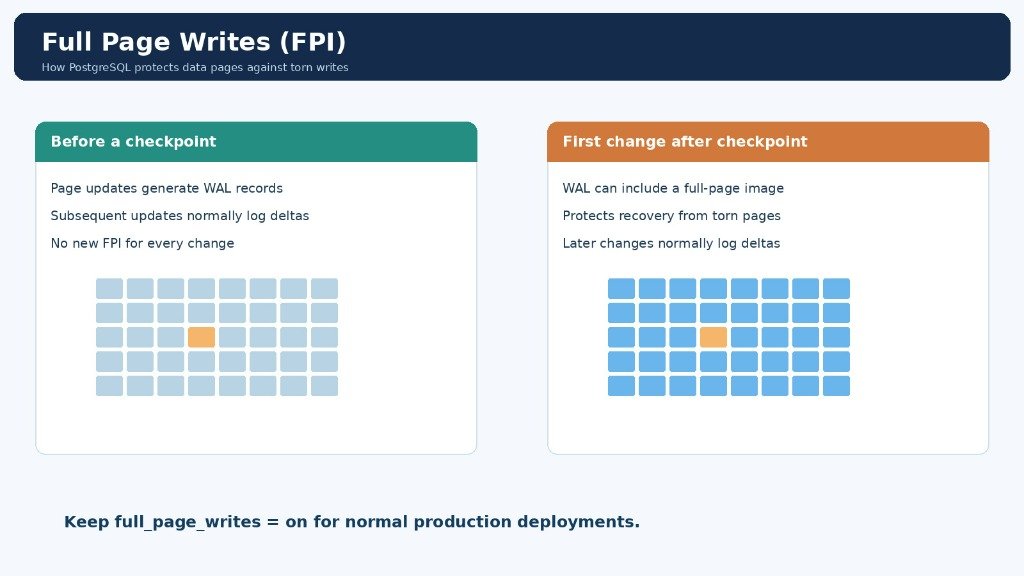
With full_page_writes = on, the first modification to an 8 KB page following a checkpoint causes PostgreSQL to write the entire 8 KB page image (Full Page Image — FPI) into WAL alongside the change delta.
| Mutation Timing | WAL Record Payload | Behavioral Impact |
|---|---|---|
| First write after checkpoint | 8 KB Full Page Image (FPI)* + Delta | Full page snapshot written to WAL |
| Subsequent writes | Delta / Change Record Only | Minimal incremental WAL size |
**FPI size varies based on compression and zero-byte alignment.*
3. Checkpoint Mechanics & Triggers
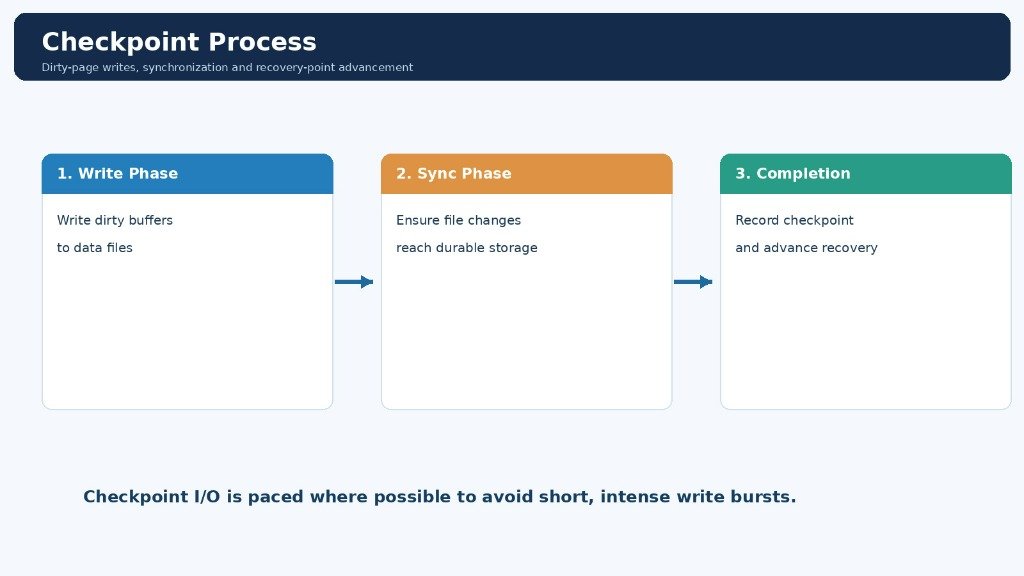
Checkpoints flush dirty pages to disk, establishing recovery baselines.
SHOW checkpoint_timeout;
SHOW checkpoint_completion_target;
SHOW max_wal_size;
SHOW min_wal_size;| Parameter | Baseline Default |
|---|---|
checkpoint_timeout | 5min |
checkpoint_completion_target | 0.9 |
max_wal_size | 1GB |
min_wal_size | 80MB |
full_page_writes | on |
4. Checkpoint Spreading
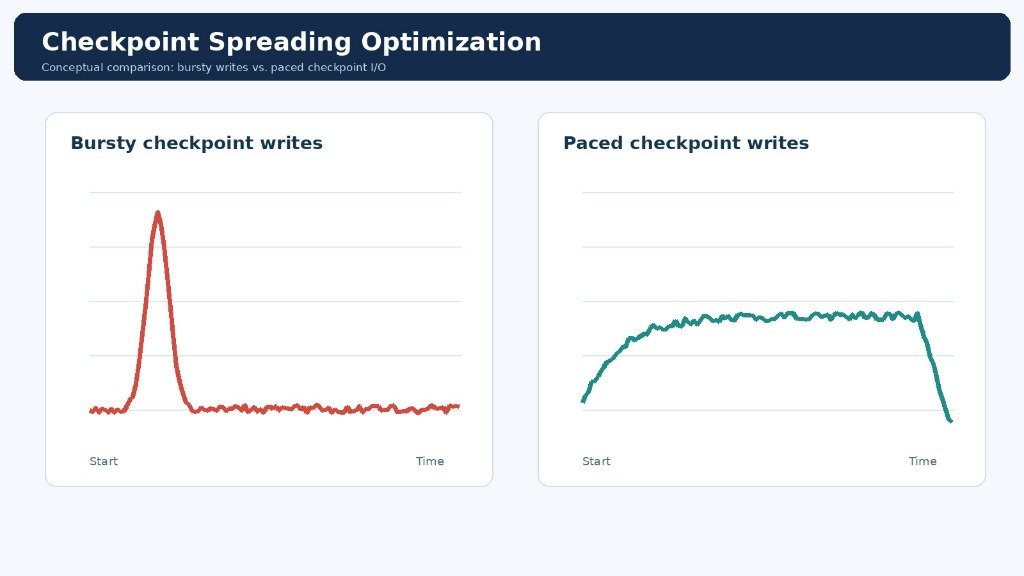
Flushing thousands of dirty buffers instantaneously generates aggressive I/O queueing and query latency jitter.
checkpoint_completion_target spreads buffer flushing across the checkpoint interval:
With checkpoint_timeout = '15min' and checkpoint_completion_target = 0.9, flushing is amortized across 13.5 minutes.
5. The WAL, FPW & Checkpoint Feedback Loop
Breaking this loop requires expanding max_wal_size, enabling wal_compression, and extending checkpoint_timeout.
6. WAL Compression Optimization
wal_compression = onCompacts full page images significantly (often 40-70% space reduction) with negligible CPU overhead under modern algorithms (lz4 / zstd).
7. Dual Telemetry & Diagnostics
-- PostgreSQL 14+ WAL Metrics
SELECT
    wal_records,
    wal_fpi,
    pg_size_pretty(wal_bytes::bigint) AS wal_size,
    wal_buffers_full,
    stats_reset
FROM pg_stat_wal;

-- PostgreSQL 17+ Checkpointer Telemetry
SELECT
    num_timed,
    num_requested,
    num_done,
    write_time,
    sync_time,
    buffers_written,
    stats_reset
FROM pg_stat_checkpointer;
8. Real-World Optimization Profile
64 GB RAM NVMe OLTP cluster experiencing checkpoint-driven latency spikes:
# Production Tuning Baseline
checkpoint_timeout = '15min'
checkpoint_completion_target = 0.9
max_wal_size = '8GB'
min_wal_size = '2GB'
full_page_writes = on
wal_compression = on
9. Capacity Planning Calculator
| Metric | Sample Value | Formula / Impact |
|---|---|---|
| Sustained WAL Rate | 20 MB/s | Peak write workload |
| Target Checkpoint Interval | 15 min | checkpoint_timeout |
| Predicted Cycle WAL | 17.6 GB | 15 min × 60 s × 20 MB/s |
| Hourly WAL Generation | 70.3 GB | 3600 s × 20 MB/s |
10. Production Checklist
- Verify active PostgreSQL major version and WAL parameters.
- Measure baseline counters via
pg_stat_wal. - Evaluate requested vs timed checkpoint ratios.
- Confirm storage write latency and IOPS headroom.
- Maintain
full_page_writes = on. - Benchmark
wal_compression = onwith lz4 or zstd. - Co-tune
max_wal_sizealongsidecheckpoint_timeout. - Audit replication lag and archive queue health.
- Verify crash recovery SLA and disk margin.
- Compare p95/p99 query latencies post-change.
11. Common Operational Pitfalls
- •Pitfall 1: Turning off
full_page_writesin production. - •Pitfall 2: Sizing up
max_wal_sizewithout recovery SLA verification. - •Pitfall 3: Relying solely on raw checkpoint counts.
- •Pitfall 4: Assuming compression has zero CPU tradeoff.
- •Pitfall 5: Treating
max_wal_sizeas a rigid disk quota.
12. Conclusion
Tuning PostgreSQL write performance demands holistic calibration of WAL generation rates, checkpoint spacing, and recovery SLAs. Sizing max_wal_size generously, maintaining spreading at 0.9, and enabling modern compression yields stable latency profiles without risking data integrity.
References
Did increasing shared_buffers always improve performance in your PostgreSQL environment?
Share your observations regarding Linux Page Cache sizing, checkpoint spikes, and memory balancing across high-RAM PostgreSQL workloads.
PostgreSQL Shared Buffers & Linux Page Cache Interaction: The Hidden Layer of Memory Management
Comprehensive architectural guide on how PostgreSQL shared_buffers and Linux OS page cache interact, buffered I/O execution pipeline, double caching mechanics, cache hit ratio realities, and dual-layer tuning.
PostgreSQL Autovacuum Tuning & XID Wraparound: Preventing the 2-Billion Transaction ID Crisis
Comprehensive architectural guide on PostgreSQL Autovacuum internals, 32-bit transaction ID (XID) aging, tuple freezing, anti-wraparound vacuum mechanics, production capacity planning, and incident runbooks.